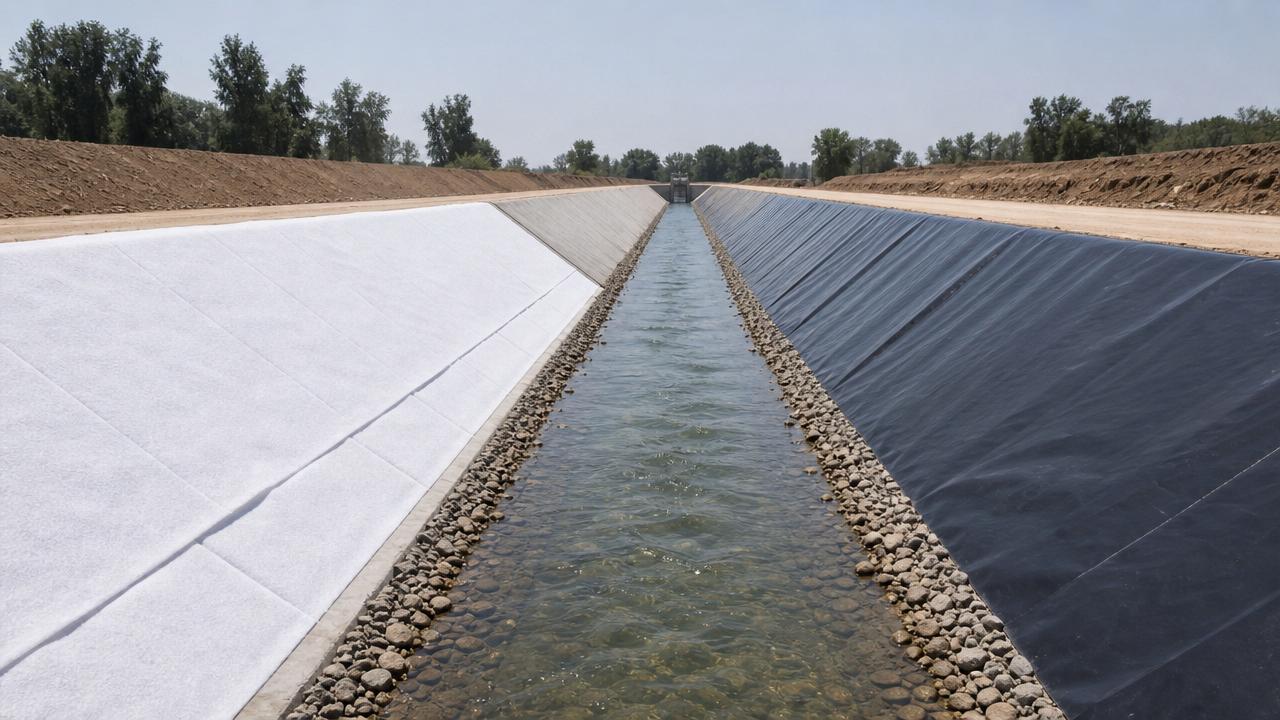
In canal lining, the move toward composite geomembrane has reshaped material selection standards. Engineers now compare not only permeability, but also puncture resistance, interface friction, construction tolerance, and maintenance risk.
Traditional geomembrane still plays an important role in seepage control. However, canal projects increasingly demand integrated barrier and protection functions, especially where subgrade variability, settlement, and installation disturbance affect long-term performance.
This shift matters across irrigation canals, water diversion systems, rehabilitation works, and lined channels in harsh environments. Understanding what changed helps teams choose a lining system that performs reliably through construction and service life.
Definition and Structural Difference
A geomembrane is a low-permeability polymer sheet used as an anti-seepage barrier. Common materials include HDPE, LDPE, PVC, EVA, and other waterproof sheets used in geosynthetic engineering.
A composite geomembrane combines a geomembrane with one or two layers of non-woven geotextile. The result is a laminated structure that adds filtration, cushioning, separation, and improved contact behavior.
In canal lining, that structural difference is not cosmetic. It changes how the liner handles stone pressure, uneven foundations, installation damage, local stress concentration, and hydraulic stability on side slopes.
Simple comparison
Why Canal Lining Requirements Changed
Older canal lining decisions often focused on immediate anti-seepage performance. Today, design teams evaluate the entire system, including substrate preparation, slope stability, repair frequency, and total lifecycle cost.
Several industry conditions accelerated interest in composite geomembrane solutions. The most important signals appear in both new construction and rehabilitation projects.
- Canal routes increasingly cross variable soils with uneven support conditions.
- Water loss control standards have become stricter in arid and water-stressed regions.
- Faster construction schedules reduce tolerance for subgrade perfection.
- Maintenance access is often limited after commissioning.
- Projects now prioritize durability under repeated wetting, drying, and thermal change.
These conditions do not eliminate standard geomembrane use. Instead, they raise the value of a lining material that better integrates sealing and mechanical protection in one system.
Current evaluation focus
What Composite Geomembrane Changed in Performance
The biggest change is that composite geomembrane is evaluated as a system component, not only as a thin waterproof film. That affects design confidence in real construction conditions.
1. Better protection against field damage
Canal foundations are rarely perfectly smooth. Embedded particles, compacted ridges, and temporary foot traffic can damage exposed sheets during placement. Geotextile layers help distribute localized stress.
This does not make the membrane indestructible. It simply reduces the likelihood that a small support defect becomes a leak path during installation or early operation.
2. Improved adaptability to subgrade variation
A canal may include cut sections, fill sections, repaired reaches, and transitions near structures. A composite geomembrane usually offers better accommodation to these changing support conditions.
The attached non-woven fabric also helps separate the membrane from fine soil movement. This can lower stress concentration where settlement or shrinkage occurs.
3. More stable construction handling
Handling thin polymer sheets in wind or on sloped canal banks can be difficult. Composite products often provide improved drape, grip, and temporary placement stability during installation.
That advantage can shorten corrective work, reduce accidental creasing, and improve consistency where site conditions are less controlled.
4. Better interface behavior in multilayer systems
Canal lining rarely consists of one material only. There may be protective soil, concrete panels, drainage components, or bedding layers. Composite surfaces often interact more favorably within these assemblies.
This can improve stability and reduce slippage risk, especially on embankment sections where smooth sheet-to-sheet contact is undesirable.
Application Value in Canal Projects
The practical value of composite geomembrane is strongest when projects need anti-seepage performance and construction robustness at the same time. This is common in hydraulic and irrigation infrastructure.
- Reduces water seepage losses in long canal sections.
- Improves liner survivability on less-than-ideal subgrades.
- Supports rehabilitation where existing canal geometry is irregular.
- Helps manage maintenance costs through lower damage incidence.
- Allows more integrated design with protective and drainage elements.
Where hydraulic safety and asset longevity are critical, material choice should reflect field risk, not only laboratory barrier data. That is where composite solutions often gain preference.
Typical canal-related scenarios
Selection and Installation Considerations
Choosing between geomembrane and composite geomembrane should start with actual project conditions. Material thickness alone does not define success in canal lining.
Key selection factors
- Subgrade roughness and particle size distribution.
- Canal slope angle and interface friction demand.
- Expected settlement, cracking, or movement.
- Exposure conditions, including UV and temperature variation.
- Repair accessibility after the canal enters service.
Installation notes
Even the best composite geomembrane cannot compensate for careless installation. Foundation trimming, seam quality control, anchoring details, and transition treatment remain decisive.
- Remove sharp debris and compact the base uniformly.
- Protect seams from contamination and excessive tension.
- Use suitable overlap, welding, or bonding methods.
- Verify panel placement around joints, culverts, and corners.
- Inspect completed work before covering or commissioning.
Reliable Supply and Technical Support
For canal lining, product consistency matters as much as design intent. Dezhou Yuchuang New Materials Co., Ltd. provides geosynthetic materials manufactured under strict national standards.
The company integrates manufacturing, research and development, seepage control design, technical consulting, and construction services. Its portfolio covers geomembranes, composite geomembrane, non-woven fabrics, waterproof sheets, drainage products, geogrids, geocells, and related systems.
With advanced production technology and comprehensive testing methods, the company supports hydraulic projects that require dependable anti-seepage materials and coordinated engineering services.
Conclusion and Next Step
What changed in canal lining is not simply the replacement of one sheet by another. The real change is a broader engineering focus on performance under actual construction and operating conditions.
A composite geomembrane often offers a stronger balance of seepage control, protection, and installation resilience than standard geomembrane alone. That balance can be decisive in modern canal systems.
When evaluating a canal lining scheme, compare barrier requirements, subgrade risk, slope conditions, and maintenance strategy together. A project-based technical review will identify whether composite geomembrane is the more reliable long-term option.
Related Posts
Contact Us
Leave A Message
If you are interested in our products and want to know more details, please leave a message here, we will reply you as soon as we can.