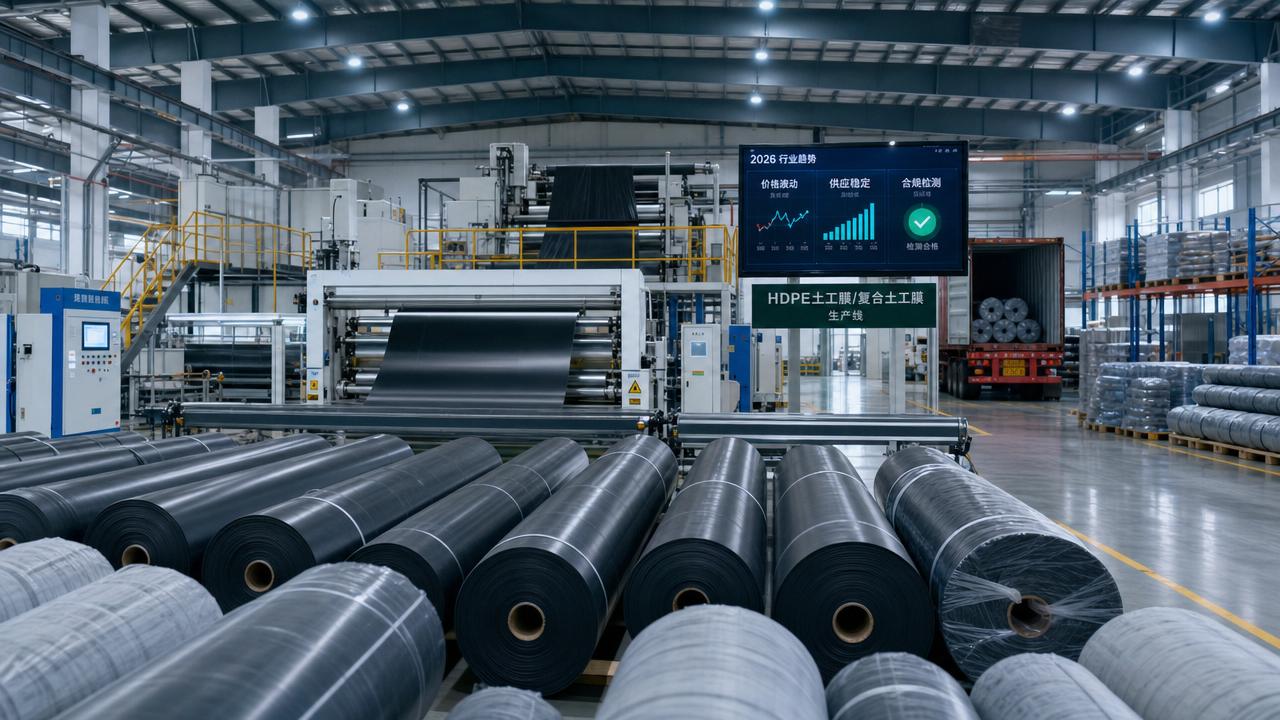
As 2026 approaches, geomembrane buyers face a more complex market shaped by resin price volatility, tightening environmental standards, logistics uncertainty, and shifting global supply capacity. For business evaluators, understanding how these factors influence geomembrane cost, availability, and project risk is essential to making informed sourcing and investment decisions before budgets and timelines come under pressure.
Why is the geomembrane market becoming harder to evaluate in 2026?
For procurement and investment teams, geomembrane is no longer a simple commodity purchase. Price per square meter still matters, but it is only one part of the decision. The larger issue is whether the selected material, supplier, and delivery plan can protect project cost, compliance, and construction continuity.
In geosynthetics, market risk often appears in stages. First comes resin fluctuation. Then lead times stretch. After that, project teams face specification mismatches, testing delays, or shipment disruption. By the time these problems become visible on site, the original low quote may already have become the highest total cost option.
The main forces affecting geomembrane pricing
- Raw material volatility, especially changes in polyethylene resin and related petrochemical feedstocks.
- Energy and utility cost pressure in manufacturing, which directly affects extrusion, calendaring, and testing operations.
- Environmental compliance costs, including stricter production controls, waste management, and traceability expectations.
- Logistics variability, including port congestion, inland transport availability, container imbalance, and route disruption.
- Demand shifts from landfills, mining, water conservancy, aquaculture, transportation, and industrial containment projects.
Business evaluators should therefore assess geomembrane not only by product category, such as HDPE, LDPE, or composite geomembrane, but also by supply chain resilience and technical support depth. A supplier that can coordinate manufacturing, testing, consulting, and construction-related support reduces hidden exposure.
Which geomembrane supply risks deserve the closest attention?
The most important supply risks in 2026 are not all visible on a quotation sheet. Some are embedded in formulation, production scheduling, packaging, or standard compliance. Others emerge only when a project requires urgent dispatch, custom thickness, or supporting geosynthetic materials from the same source.
Priority risk checklist for commercial evaluation
- Capacity concentration risk: if too much supply depends on a narrow group of plants or regions, any local disruption can affect global availability.
- Specification substitution risk: a low-cost offer may not match required thickness tolerance, tensile behavior, or puncture resistance expectations.
- Documentation risk: incomplete quality records, test reports, or shipment data can delay project acceptance.
- Bundling risk: when a project needs geomembrane plus nonwoven geotextile, GCL, drainage products, or geogrids, fragmented sourcing increases coordination cost.
- Delivery timing risk: long production queues or weak transport planning can create site idle time and liquidated damage exposure.
A stronger supplier profile matters here. Dezhou Yuchuang New Materials Co., Ltd. combines manufacturing with research and development, seepage control design, technical consulting, and construction services. For evaluators, this matters because supply reliability improves when product knowledge and application knowledge are connected instead of isolated.
How do raw materials and product type change geomembrane price?
Not all geomembrane products respond to market pressure in the same way. Resin type, thickness, surface structure, and whether the system includes a composite layer all influence price movement. A procurement team that understands these differences can avoid false comparisons between products that serve different risk profiles.
The table below summarizes how common geomembrane categories tend to differ in commercial evaluation. It is not a universal price list, but a decision aid for comparing cost drivers and sourcing complexity.
This comparison shows why a direct unit-price comparison can be misleading. A composite geomembrane may carry a higher initial material price than a basic membrane, but if it reduces separate geotextile handling, field damage risk, or installation steps, the total installed cost may be more favorable.
What should business evaluators compare beyond the quoted price?
A competitive quote becomes meaningful only when it is linked to specification detail, delivery capability, and project support. In geosynthetic procurement, the lowest visible price can hide the highest downstream exposure if the supplier cannot maintain consistency across batches or support technical clarification during execution.
Key evaluation dimensions
- Material fit: thickness, tensile performance, elongation behavior, puncture resistance, and environmental stress suitability should align with project conditions.
- Manufacturing discipline: production equipment, testing precision, and standard-based quality control affect consistency more than sales language does.
- Integrated supply: if one manufacturer can also provide nonwoven fabrics, drainage nets, GCL, geogrids, and related geosynthetics, coordination risk falls.
- Technical response speed: procurement teams need answers on application, joint system design, and substitution options before site delays occur.
- Location and logistics: transport access affects lead time predictability, especially for large-volume projects with phased delivery.
Dezhou Yuchuang New Materials Co., Ltd. offers a relevant advantage in this area. Its business is not limited to manufacturing. It also covers research and development, seepage control design, technical consulting, and construction services. For evaluation teams, this broader capability helps close the gap between product procurement and project performance.
A practical geomembrane procurement matrix for 2026
The following matrix can help commercial teams structure a geomembrane sourcing decision. It is especially useful when comparing multiple suppliers under tight budget and timeline pressure.
This matrix highlights an important truth: geomembrane procurement is a system decision. When the liner must perform alongside filtration, drainage, reinforcement, or waterproofing components, supplier breadth becomes a measurable commercial advantage rather than a marketing detail.
How do application scenarios change the right geomembrane choice?
Business evaluators should avoid one-size-fits-all sourcing. The right geomembrane for a landfill cell is not always the right choice for aquaculture ponds, water conservancy channels, industrial lagoons, or transportation-related seepage control. Application risk shapes product selection and lifecycle cost.
Scenario-based selection points
- Landfill and waste containment: chemical resistance, weld integrity, and long-term barrier stability usually carry higher priority than initial material price.
- Mining and tailings: puncture resistance, subgrade interaction, and supply reliability matter because installation interruption can affect larger project chains.
- Aquaculture and agricultural water storage: cost sensitivity is often higher, but UV exposure, handling convenience, and leak control still require disciplined selection.
- Canals, reservoirs, and hydraulic works: surface condition, anchoring detail, and compatibility with geotextile or drainage layers influence the best system design.
Because Dezhou Yuchuang New Materials Co., Ltd. manufactures geomembranes alongside nonwoven fabrics, composite geomembranes, waterproofing sheets, drainage materials, GCL, geogrids, and geocells, project teams can evaluate combined solutions instead of isolated products. This is valuable when the application calls for layered seepage control rather than a single liner roll.
What compliance and quality signals should buyers review?
In the geosynthetics sector, compliance is not only about a document pack. It reflects how a manufacturer controls raw materials, testing, production records, and product release. When requirements tighten in 2026, buyers should focus on evidence that the geomembrane is produced according to applicable standards and that the testing process is complete and traceable.
Useful review points
- Request clear confirmation of the applicable national, project, or industry standard before order release.
- Check whether testing instruments and testing methods are sufficiently comprehensive for the required specification.
- Review sample retention, batch traceability, and inspection frequency where project value justifies deeper control.
- Confirm packaging, labeling, and shipment identification to reduce receiving and installation confusion.
The company profile of Dezhou Yuchuang notes advanced production technology, precise testing instruments, comprehensive testing methodologies, and manufacturing in strict compliance with national standards. For commercial buyers, these are not background details. They directly support risk reduction in acceptance, documentation, and technical consistency.
How can buyers reduce total cost instead of chasing the lowest geomembrane price?
A better commercial question is not “Who offers the cheapest geomembrane?” but “Which sourcing plan produces the lowest total project cost with acceptable risk?” That broader view usually changes supplier ranking.
Ways to control total landed and installed cost
- Lock technical specifications early so suppliers quote on the same basis and later substitution disputes are avoided.
- Bundle compatible geosynthetic materials where possible to reduce split deliveries and interface claims.
- Align shipment schedule with installation sequence to limit storage damage and on-site handling cost.
- Use sample review and pre-order technical confirmation for critical projects rather than relying on brochure-level comparison.
- Account for technical consulting value, especially when seepage control design and material selection interact closely.
For many business evaluators, this is where a diversified geosynthetics manufacturer becomes more competitive than a narrow trader. When technical clarification, design coordination, and supporting materials come from one organization, transaction friction declines and accountability becomes clearer.
FAQ: common geomembrane questions from business evaluators
How should I compare geomembrane quotations from different suppliers?
Compare them on a matched specification basis first. Review thickness, resin type, roll dimensions, surface type, test items, compliance basis, delivery terms, and whether supporting geosynthetics are included. If one quote is much lower, verify that it is not based on a thinner product, looser tolerance, or reduced documentation scope.
Which projects are most sensitive to geomembrane supply risk?
Large containment, landfill, mining, reservoir, and infrastructure projects usually face the highest exposure. These projects often require phased deliveries, strict inspection, and reliable system compatibility. A short delay in geomembrane arrival can interrupt earthworks, welding teams, and downstream installation activities.
Is composite geomembrane always a better value than single-layer geomembrane?
Not always. Composite geomembrane can improve puncture protection and installation efficiency in some scenarios, but the best value depends on subgrade condition, stress environment, and whether a separate geotextile layer is already planned. Evaluation should consider system cost, not material label alone.
What lead-time questions should buyers ask before placing a geomembrane order?
Ask about production scheduling, standard stock versus custom production, packaging preparation, transport route, batch release process, and whether related products can ship together. For multi-stage projects, confirm partial shipment planning rather than assuming one-time dispatch.
Why choose us for geomembrane sourcing and project evaluation support?
Dezhou Yuchuang New Materials Co., Ltd. serves buyers who need more than a basic material quote. The company integrates manufacturing of geomembrane and other geosynthetic materials with research and development, seepage control design, technical consulting, and construction services. That combination helps business evaluators reduce uncertainty at both procurement and implementation stages.
Its product scope includes geomembranes, composite geomembranes, long-filament and short-filament non-woven fabrics, PE/PVC/EVA/ECB waterproofing sheets, GCL sodium-bentonite waterproofing blankets, drainage nets, drainage boards, geogrids, geocells, three-dimensional soil stabilization mats, composite waterproofing sheets, and plastic blind ditches. For projects requiring integrated seepage control systems, this range can simplify sourcing decisions.
You can contact us to discuss
- Geomembrane parameter confirmation for your target application and budget range.
- Product selection between geomembrane, composite geomembrane, geotextile-supported systems, and related geosynthetics.
- Estimated delivery cycle, shipment planning, and coordination for phased project schedules.
- Custom solution discussion for seepage control, drainage, reinforcement, and waterproofing combinations.
- Certification and standard alignment questions based on project documentation requirements.
- Sample support, quotation communication, and preliminary technical consultation before formal procurement.
For 2026 planning, the best time to review geomembrane options is before budgets harden and site schedules compress. Early supplier evaluation creates room to compare technical fit, supply reliability, and total cost with far more control than a last-minute purchase ever can.
Related Posts
Contact Us
Leave A Message
If you are interested in our products and want to know more details, please leave a message here, we will reply you as soon as we can.