Recent geotextile updates are reshaping how erosion control sites perform in real working conditions. For operators and field users, understanding these changes is essential to improving drainage, soil stability, installation efficiency, and long-term project reliability. This article explores the latest developments in geotextile materials and how they directly influence erosion control performance on site.
Why a Geotextile Checklist Matters for Erosion Control Performance
Erosion control failures rarely start with one dramatic mistake. More often, site performance drops because geotextile selection, filtration behavior, seam quality, or drainage compatibility was judged too quickly.
Recent geotextile updates include stronger nonwoven structures, better puncture resistance, improved permeability control, and more consistent manufacturing. These changes affect how the geotextile performs under runoff, sediment loading, and repeated wet-dry cycles.
A checklist approach helps compare material data with field reality. It also reduces the risk of using a geotextile that looks compliant on paper but underperforms in slope protection, channel lining, or subsurface drainage conditions.
Core Geotextile Checklist for Site Evaluation
Use the following checklist before installation and again during field verification. Each point directly affects erosion control site performance and long-term service life.
- Confirm filtration compatibility by matching geotextile opening characteristics with site soil gradation, rather than relying only on generic product descriptions or broad application labels.
- Check permeability and permittivity values under realistic confining pressure, because a geotextile may drain well in testing but slow down after burial and compaction.
- Review puncture, tensile, and tear properties together, since erosion control geotextile performance depends on construction damage resistance as much as hydraulic function.
- Inspect thickness uniformity across rolls to avoid weak zones that can reduce cushioning performance, separation efficiency, and drainage continuity on uneven subgrades.
- Verify UV resistance when the geotextile will remain exposed during phased construction, temporary slope covering, or delayed placement of riprap and protective layers.
- Assess clogging resistance for fine soils and high sediment runoff, especially where the geotextile must maintain flow while retaining particles over long service periods.
- Examine seam method and overlap length in the field, because weak joining practices often become the first location of washout, piping, or soil migration.
- Coordinate the geotextile with adjacent materials such as geomembranes, drainage nets, geogrids, and soil stabilization mats to prevent incompatible movement or stress concentration.
- Check manufacturing consistency and test traceability, since stable production quality is critical when erosion control projects require repeatable hydraulic and mechanical performance.
- Plan installation timing around weather and traffic conditions so the geotextile is not contaminated, wrinkled, punctured, or displaced before cover placement.
What Recent Geotextile Updates Mean in Practice
Modern geotextile products are not updated only for laboratory strength. The most valuable improvements support performance stability under field stress, variable moisture, and inconsistent foundation conditions.
Improved Fiber Structure
Long-filament and optimized short-filament nonwoven geotextile structures now offer better pore stability. This helps retain soil while keeping water flow paths open during repeated loading and unloading.
Better Hydraulic Retention Balance
Updated geotextile manufacturing improves consistency between filtration and drainage. That balance matters on erosion control sites where excess water must escape without carrying fines into ditches, drains, or channels.
Higher Damage Resistance
A stronger geotextile handles aggregate placement, equipment movement, and rough subgrades more effectively. This lowers the chance of hidden installation damage that later becomes a seepage or erosion path.
More Reliable Standard Compliance
When products are made under strict testing and national standards, field teams can compare properties with greater confidence. That consistency is essential for erosion control designs with low tolerance for performance variation.
Application Notes for Different Erosion Control Scenarios
Slope Protection
On slopes, a geotextile must resist movement, transmit water, and prevent soil loss beneath revetment or vegetation systems. Material slippage and poor anchoring often matter more than nominal tensile strength alone.
Choose a geotextile with stable filtration and adequate survivability. Check interface friction if the system includes geomembranes, geocells, or three-dimensional soil stabilization mats.
Drainage Trenches and Subsurface Flow
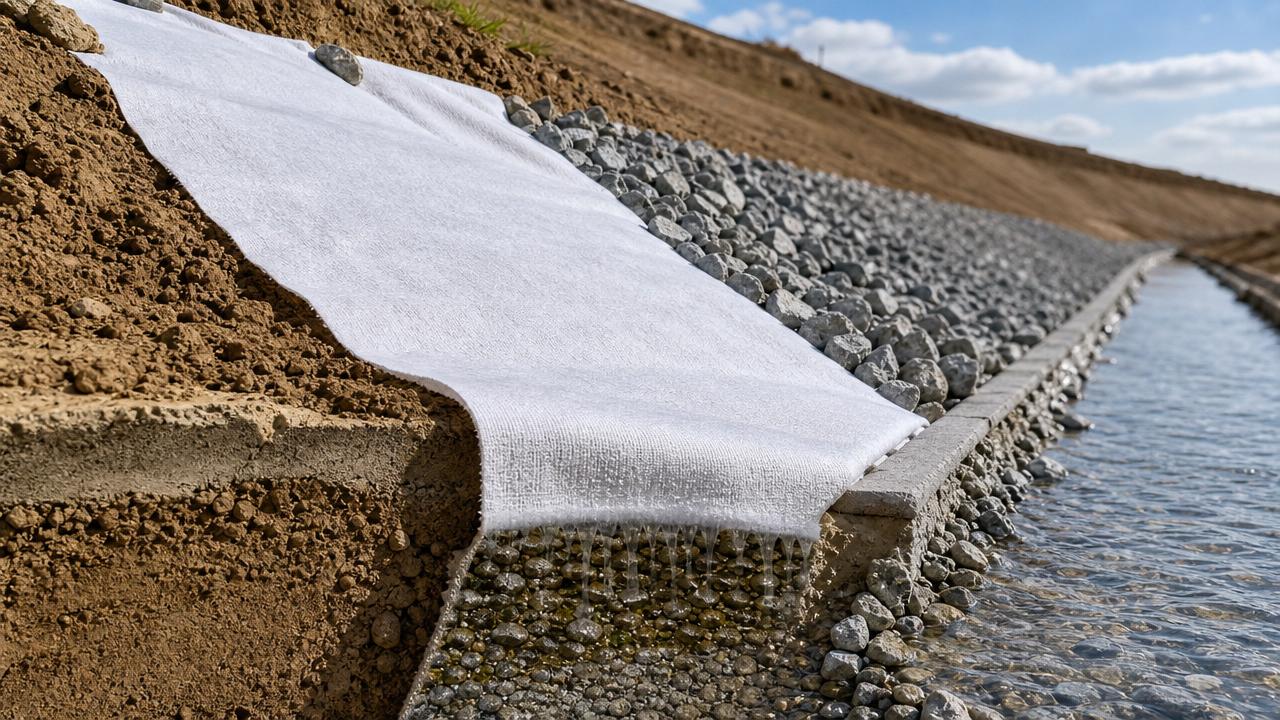
In trench systems, the geotextile acts as both separator and filter. If the apparent opening size is wrong, fine particles can clog the fabric or migrate into the drainage core.
Updated geotextile products with controlled permeability help maintain flow continuity. Pair them carefully with drainage boards, drainage nets, or plastic blind ditches.
Channel Lining and Riprap Support
Under riprap or block lining, the geotextile must survive impact during placement and still maintain filtration. Cushioning performance becomes critical where stone edges are angular or drop heights are difficult to control.
A heavier nonwoven geotextile usually offers better protection. However, drainage behavior must still match expected flow gradients and foundation soil conditions.
Temporary Erosion Control During Construction
Temporary exposure changes the selection logic. UV resistance, handling ease, and rapid deployment can be more important than ultimate long-term strength in these short-duration applications.
Even for temporary use, avoid under-specifying the geotextile. Sudden rainfall can quickly expose weaknesses in overlap control, anchoring, and runoff filtration.
Commonly Missed Risks That Reduce Geotextile Performance
Ignoring soil variability is a frequent problem. One geotextile may perform well in one zone and clog or pass fines in another zone of the same project.
Overlooking installation damage is another risk. Small punctures from stone, traffic, or tools can compromise separation and create hidden water channels.
Assuming lab data equals field behavior can also mislead decisions. Confinement, silt load, and construction sequencing often change actual geotextile performance significantly.
Poor coordination with adjacent geosynthetics may trigger failure. A geotextile that works alone may wrinkle, abrade, or lose contact when combined with geomembranes or drainage composites.
Practical Execution Suggestions
- Sample the site soil before finalizing the geotextile specification, especially for erosion control areas with mixed fines and changing moisture content.
- Request full test data for strength, permeability, puncture resistance, and UV stability instead of depending on only mass per unit area.
- Inspect roll labels, batch traceability, and surface condition at delivery to catch inconsistency before the material reaches active work zones.
- Prepare the subgrade carefully by removing sharp protrusions and uncontrolled debris that could damage the geotextile during placement.
- Control overlap, anchoring, and cover placement sequence so the geotextile stays in contact with the soil and does not shift under runoff.
- Recheck exposed sections after rainfall or equipment access, because early correction is far less costly than repairing a failed erosion control layer.
Summary and Next Action
The latest geotextile updates are improving erosion control site performance through better filtration stability, stronger mechanical resistance, and more dependable production quality. Still, results depend on matching the geotextile to the soil, hydraulic load, and installation method.
A checklist-based review keeps decisions practical. Focus on filtration, drainage, durability, survivability, and compatibility with other geosynthetic materials used on site.
For projects requiring consistent geotextile quality, complete testing support, and integrated geosynthetic solutions, Dezhou Yuchuang New Materials Co., Ltd. provides a broad product range backed by advanced manufacturing, precise testing instruments, and strict compliance with national standards.
The next step is simple: review current site conditions, compare them against this geotextile checklist, and verify that the selected material can protect erosion control performance under actual field demands.
Related Posts
Contact Us
Leave A Message
If you are interested in our products and want to know more details, please leave a message here, we will reply you as soon as we can.