
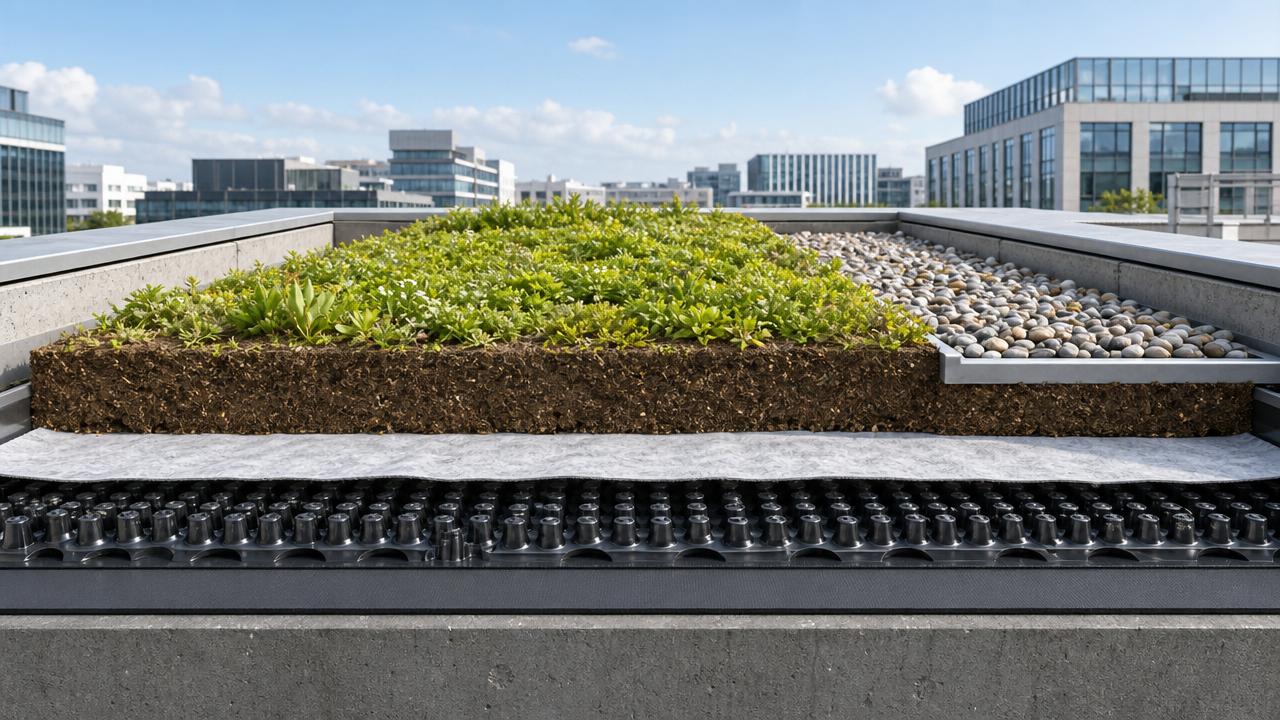
As green roof budgets face tighter scrutiny this year, the cost of drainage board systems has become a practical decision point across many projects.
A drainage board is no longer compared by unit price alone. Load resistance, water flow, membrane protection, and installation speed now affect total project cost.
In geosynthetic roofing applications, small specification changes can shift long-term value. That is why drainage board selection should match the exact roof scenario.
This article explains where drainage board cost shifts are happening, which green roof situations are most affected, and how to evaluate better-fit options.
Why drainage board costs are changing across green roof scenarios
This year, drainage board pricing is being influenced by resin costs, transportation pressure, labor efficiency, and stronger performance expectations on complex roofs.
At the same time, green roof designs are becoming more layered. Waterproofing protection, root barriers, filter layers, and growing media must work together.
Because of this, a drainage board with lower purchase cost may create higher installation or maintenance expenses later.
In geosynthetics, the right drainage board must be judged by compressive strength, discharge capacity, thickness stability, and compatibility with adjacent materials.
The main drivers behind this year’s cost movement
- Raw material fluctuations affecting HDPE and related polymer pricing
- Higher demand for stronger drainage board structures on intensive roofs
- Freight and packaging costs for bulk, lightweight but high-volume materials
- Growing preference for integrated drainage board and filter combinations
- Tighter quality control expectations for long-term rooftop durability
Scenario one: extensive green roofs where drainage board cost control matters most
Extensive green roofs usually use shallow growing media, lighter vegetation, and broad coverage areas. Here, drainage board quantity is large, so cost sensitivity is high.
However, choosing the cheapest drainage board can be risky. Large roof areas magnify installation problems, drainage gaps, and uneven support under the planting system.
For this scenario, the key judgment points are stable water discharge, easy overlapping, and reliable protection of the waterproofing membrane.
A lightweight drainage board with consistent cavity structure often reduces labor time and lowers breakage during transport and placement.
What affects value in extensive roof use
- Coverage area and repeatability of layout
- Speed of installation under weather constraints
- Resistance to compression from media and foot traffic
- Drainage board consistency over long roof spans
Scenario two: intensive green roofs where drainage board performance raises cost
Intensive green roofs carry deeper soil, larger plants, irrigation systems, and more maintenance traffic. These conditions increase structural demand on every drainage board layer.
In this setting, drainage board cost often rises because the product must resist higher loads without losing drainage channels.
Boards with stronger stud geometry or higher compressive strength may cost more initially, yet they protect performance over time.
When drainage paths collapse, waterlogging can stress root zones, overload structures, and increase repair complexity above occupied spaces.
Core checks for intensive roof projects
- Long-term compressive performance under saturated media
- Drainage board discharge rate under actual roof loads
- Compatibility with root barriers and waterproofing sheets
- Durability during maintenance access and landscaping work
Scenario three: podium decks and parking roofs with mixed drainage board demands
Podium landscapes and parking deck roofs combine green roof goals with structural and access constraints. These projects rarely fit a single standard drainage board choice.
Some zones need stronger drainage board support because of pavers, service loads, or concentrated maintenance paths.
Other zones may prioritize water retention balance for planting performance. This mix can shift average material cost upward.
The best approach is often zoning the roof by load and drainage risk rather than using one drainage board everywhere.
How different green roof scenarios change drainage board requirements
Practical ways to match drainage board selection with each project scene
A good drainage board decision starts with the roof condition, not the catalog page. Performance should be reviewed under real load, slope, and layer arrangement.
The following actions help control cost without reducing roof reliability.
- Separate low-load and high-load zones before selecting a drainage board specification.
- Check compressive strength together with drainage capacity, not as isolated values.
- Compare installation productivity, especially on large roofs with weather exposure.
- Review compatibility with geomembranes, composite sheets, and filter fabrics.
- Estimate maintenance risk if the drainage board deforms after loading.
Where geosynthetic system thinking creates savings
Drainage board value improves when paired correctly with non-woven geotextiles, waterproofing membranes, and protective layers.
As a technology-driven geosynthetics company, Dezhou Yuchuang New Materials Co., Ltd. supports this integrated approach.
Its product range includes drainage boards, drainage nets, geomembranes, composite geomembranes, and long-filament or short-filament non-woven fabrics.
This combination helps align drainage board selection with waterproofing protection, filtration, and long-term roof stability.
Common mistakes that distort drainage board cost evaluation
One common error is treating every green roof as the same. A drainage board suited for shallow sedum roofs may fail under deeper landscape loads.
Another mistake is comparing only thickness. Thickness alone does not guarantee drainage board strength, discharge performance, or service life.
Some projects also ignore installation variables. Difficult overlaps, fragile studs, or poor edge treatment can increase labor and waste.
A final oversight is neglecting product quality control. In geosynthetic applications, consistent manufacturing directly affects drainage board reliability on large roof areas.
What to do next when reviewing drainage board options this year
Start by identifying the exact roof scenario, expected loading, planting depth, and drainage path length. Then compare drainage board options against those conditions.
Ask for technical data that reflects real application needs, including compressive behavior, discharge capacity, and material consistency.
It is also useful to review the full geosynthetic system, especially if membranes, geotextiles, and drainage board layers must work together.
With advanced production technology, precise testing instruments, and manufacturing aligned with national standards, Dezhou Yuchuang New Materials Co., Ltd. offers dependable support for project evaluation.
For green roof planning this year, the smartest drainage board choice is the one that balances specification accuracy, installation efficiency, and lifecycle value.
Related Posts
Contact Us
Leave A Message
If you are interested in our products and want to know more details, please leave a message here, we will reply you as soon as we can.