
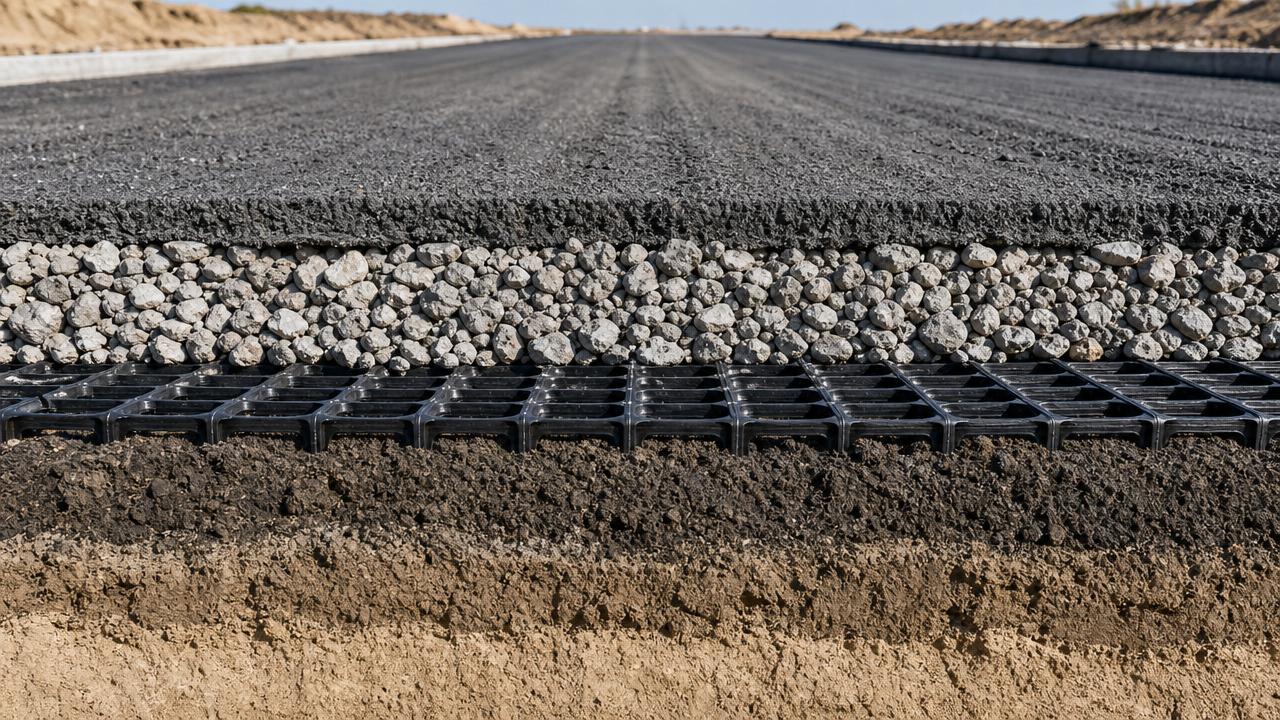
As road projects face heavier traffic loads and stricter performance targets in 2026, choosing the right geogrid has become critical for road base stability, cost control, and long-term durability.
Selection is no longer based only on tensile strength. Engineers now compare stiffness, junction efficiency, confinement behavior, installation survivability, and compatibility with aggregate and subgrade conditions.
In geosynthetics, a well-matched geogrid can reduce rutting, control lateral spread, improve load distribution, and support thinner base sections without sacrificing performance.
This guide explains the main geogrid selection trends for 2026 through practical questions, helping road base decisions become more reliable and easier to verify.
What is driving geogrid selection trends for road base stability in 2026?
Several factors are reshaping how geogrid is specified. Traffic volumes are increasing, axle loads are heavier, and pavement owners expect longer service life with fewer interventions.
At the same time, budgets remain tight. This pushes projects toward value-based geogrid selection instead of choosing the lowest initial material price.
Another trend is performance verification. More designs now require measurable reinforcement benefit, not only catalog data or nominal tensile values.
Sustainability also matters more in 2026. A geogrid that extends pavement life or reduces aggregate thickness can lower material use, transport demand, and maintenance frequency.
Key trend signals
- Greater use of design-by-performance criteria
- More attention to base course confinement
- Stronger focus on installation damage resistance
- Broader use of geogrid over weak or variable subgrades
- Preference for systems that simplify construction scheduling
How should geogrid performance be understood beyond tensile strength?
A common mistake is treating geogrid selection as a simple strength comparison. Road base stability depends on how the geogrid interacts with aggregate under repeated traffic loading.
Stiffness at low strain is often more useful than high ultimate strength. Base reinforcement works through confinement and interlock, which occur early in deformation.
A geogrid with strong ribs but weak junctions may perform poorly. Junction efficiency affects load transfer across the aperture network.
Aperture size must also fit the aggregate gradation. Proper interlock helps the geogrid restrain lateral particle movement and stabilize the base layer.
Performance factors to check
- Tensile stiffness at service strain
- Junction strength and junction stiffness
- Aperture geometry and aggregate interlock
- Creep resistance for long-term loading
- Resistance to installation damage and abrasion
- Durability in chemical, wet, or freeze-thaw conditions
For road base use, the best geogrid is the one that delivers stable confinement under actual field strains, not the one with the most impressive isolated laboratory number.
Which geogrid types are preferred for different road base conditions?
Not every geogrid fits every pavement structure. Material type, rib configuration, and mechanical behavior should match the subgrade and traffic demand.
Biaxial geogrid
Biaxial geogrid is widely used where loads act in multiple directions. It is often selected for base stabilization on roads with moderate to heavy traffic.
It performs well when aggregate confinement in both machine and cross-machine directions is important.
Triaxial or multi-directional geogrid
Multi-directional geogrid is gaining attention in 2026 because traffic stresses are complex, especially at intersections, curves, terminals, and industrial yards.
These products can offer more uniform confinement under changing load paths.
Uniaxial geogrid
Uniaxial geogrid is better known for retaining structures and steep slopes. It is less common as the primary road base stabilization layer.
However, it may appear in special edge restraint or transition applications.
Composite geosynthetic solutions
In weak subgrade conditions, geogrid may be paired with nonwoven geotextile or other geosynthetic layers for separation, filtration, or drainage.
This integrated approach is becoming more common where moisture management is part of road base stability.
How do subgrade, aggregate, and climate affect geogrid selection?
A geogrid should never be selected in isolation. Field performance depends on the complete pavement foundation environment.
Soft, pumping, or highly variable subgrades usually require stronger stabilization benefits. In such cases, geogrid selection should be tied to CBR, moisture, and expected deformation.
Aggregate shape matters too. Angular aggregate typically interlocks better with geogrid than rounded stone, improving confinement and rut resistance.
Climate introduces durability demands. Wet zones need careful attention to drainage and separation. Cold regions require geogrid systems that tolerate freeze-thaw cycling and construction damage.
Practical checks before final selection
- Review subgrade strength, moisture variation, and seasonal instability.
- Confirm aggregate gradation against geogrid aperture dimensions.
- Evaluate expected traffic repetitions and heavy load frequency.
- Check chemical exposure, drainage needs, and temperature extremes.
- Verify installation methods, overlap details, and compaction procedures.
What selection mistakes create risk in road base geogrid applications?
One major risk is choosing geogrid by price only. A cheaper product may increase aggregate demand, shorten pavement life, or raise maintenance costs later.
Another mistake is ignoring installation survivability. If the geogrid is damaged during spreading and compaction, the expected reinforcement benefit may not be achieved.
Mismatched aperture size is also common. Poor aggregate interlock reduces confinement and limits the stabilization effect.
Some projects also overlook drainage. A geogrid can improve structural behavior, but trapped water still weakens the base and subgrade.
Warning signs during specification review
- No relation between geogrid properties and design objective
- No installation damage requirement
- No reference to aggregate compatibility
- No field quality control for placement tension and overlap
- No plan for drainage or separation in wet ground
How can geogrid selection improve cost efficiency and construction outcomes in 2026?
The most effective geogrid decisions balance upfront cost with lifecycle benefit. Good selection can reduce rutting, extend maintenance intervals, and support thinner aggregate sections.
Construction efficiency is another advantage. A geogrid that is easy to place, stable under traffic, and compatible with local materials helps keep schedules on track.
In 2026, many projects are moving toward evidence-based procurement. This means evaluating geogrid with performance data, field history, and technical support instead of brochure claims alone.
Dezhou Yuchuang New Materials Co., Ltd. supports this trend through advanced production technology, precise testing instruments, and comprehensive geosynthetic product manufacturing under national standards.
Its geosynthetic portfolio includes geogrid, geomembrane, drainage materials, geocells, nonwoven fabrics, and related road foundation solutions for complex site conditions.
Quick comparison table for geogrid selection
What should be the next step when specifying geogrid for road base projects?
Start with the road condition, not the product list. Define whether the main goal is stabilization, reinforcement, separation, rut reduction, or section optimization.
Then compare geogrid options using actual project conditions. Include subgrade strength, aggregate source, traffic demand, drainage, and construction methods.
Request technical data that explains field relevance. Reliable geogrid selection in 2026 depends on performance context, not isolated marketing values.
For projects needing dependable geosynthetic support, Dezhou Yuchuang New Materials Co., Ltd. offers a broad materials platform, technical capability, and production strength for road base applications.
A better geogrid decision today can mean stronger road base stability, lower maintenance pressure, and more predictable pavement performance for years ahead.
Related Posts
Contact Us
Leave A Message
If you are interested in our products and want to know more details, please leave a message here, we will reply you as soon as we can.